Invasive Mussel Prevention at Mill Creek Ponds: Clean, Drain, Dry!

Funding of this project has been provided in full or in part through an agreement with the California State Parks Division of Boating and Waterways (DBW). The contents of this webpage do not necessarily reflect the views and policies of the DBW, nor does mention of trade names or commercial products constitute endorsement or recommendation of their use.


What are quagga and zebra mussels?

Quagga and zebra mussels are freshwater mussels native to Eastern Europe. Outside their native range, they are a highly invasive species that can cause ecological and economic damage. Since their introduction to the United States (in the Great Lakes area) in the late 1980’s, these mussels have caused problems costing billions of dollars in response by U.S resource agencies and private industry. The appearance of invasive mussel species in California in recent years has heightened concern that these species may continue to infest other waterways in California, with the potential of impacting aquatic ecosystems resulting in the need for costly control efforts.


Approx. 1.5” adult Quagga Mussel from Wikipedia


Approx. 2” adult Zebra Mussel from US Geological Survey

Why are quagga and zebra mussels a problem?

Quagga and zebra mussels can reproduce quickly, clog pipes and ruin boat motors. The mussels can tolerate a wide range of habitat conditions, survive fairly high temperatures and low dissolved oxygen levels, and a wide range of pH levels.

Once established, zebra and quagga mussels form dense mats that can blanket infrastructure, water pipes, and boat hulls. In addition, they alter water chemistry, water clarity, and aquatic habitat.

Transferring a boat from an infested body of water to another may spread the mussels. Boaters must Clean, Drain and Dry their boats, trailers and vehicles each time they take the boat out of a lake or reservoir.
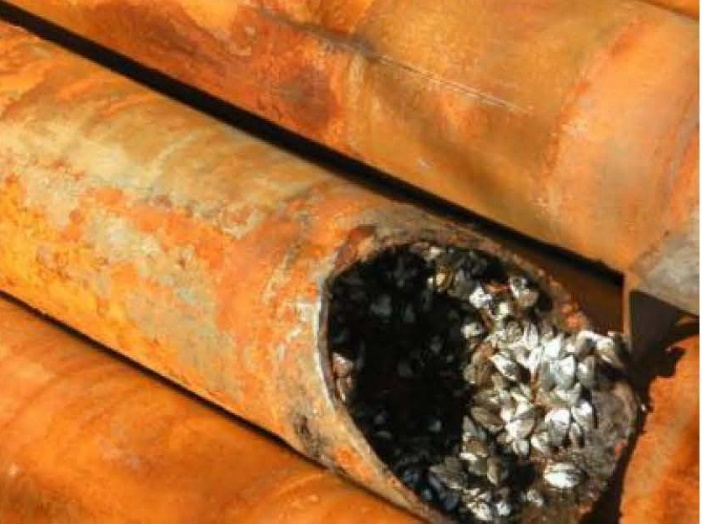

Pipe encrusted with mussels. Photo by Gemma Grace.

Where are quagga and zebra mussels found?

There are currently no quagga or zebra mussels in North Coast waterways, including Mill Creek Ponds, Lake Sonoma, or Lake Mendocino.

Let’s keep it that way!

As of 2019, the closest location of a mussel-infested waterbody was San Justo Reservoir in San Benito County, approximately 260 miles south of Mill Creek County Park. That distance is not significant in terms of exposure of the Mill Creek Ponds to quagga and zebra mussels. The continued expansion of these species to other waterbodies due to human activities represents a threat that does not diminish with distance.

If you are interested in obtaining the latest early detection mussel monitoring (EDMM) data for the Mill Creek Ponds, please contact the Mendocino County Water Agency at (707) 463-4363.

Golden Mussels: A New Invasive

In October 2024, the invasive golden mussel (Limnoperna fortunei) was detected for the first time in North America, in the Sacramento-San Joaquin Delta. Although golden mussels are not closely related to Quagga and Zebra (QZ) mussels, they look similar to these species and pose a similar social, environmental, and economic threat.


Golden mussels attached to a rope, Port of Stockton
Photo: Kristin Hubbard, CDFW

Golden mussels, San Joaquin County. Photo: Jeb Bjerke, CDFW

Like QZ mussels, adult golden mussels are typically under 1.5 inches in length. You will find them firmly attached to hard and semi-hard surfaces, with the shell margins opposite of the attached side. As their name suggests, golden mussels have shells that are light golden to darker yellowish-brown to brown in color.

Golden mussels can grow in colonies as dense as 80,000-200,000 organisms per square meter. Golden mussel colonies can clog water systems, jam up hydroelectric power generation, and damage watercraft. Golden mussels also consume many of the same microscopic organisms that native species subsist on, meaning that they can outcompete and displace species native to infested watersheds. For more information, see:

What can I do to prevent the spread of quagga and zebra mussels?

Clean, Drain, and Dry!

To prevent the spread of quagga and zebra mussels, Clean, Drain and Dry. Inspect all exposed boat surfaces when leaving the water. Small mussels feel like sandpaper to the touch. Be sure to:

  • Clean the hull of each watercraft thoroughly and remove all plant and animal material.
  • Clean and dry all live-wells.
  • Dispose of all bait in the trash.
  • Drain all water and dry all areas.
  • Drain and dry all buckets.
  • Dry the vessel for five days in hot weather and up to 30 days when cool and moist.
  • Keep watercraft dry between launches in different bodies of freshwater.
  • Report sightings of quagga and zebra mussels by contacting the California Department of Fish and Wildlife at invasives@wildlife.ca.gov.

Resources

Before launching and leaving, inspect everything! Compartments, PaddleLook for Mussels here: vehicle, trailer, anchor, dock lines, rollers, hull, axle, live wells, bilge, motor. Check your boat, trailer and vehicle

North Coast Consortium

North Coast communities and local governments are working together to prevent the spread of invasive quagga and zebra mussels into our waterways.

About the Consortium

Mussel Infestation Map

There are currently no quagga or zebra mussels in North Coast waterways. View map of the California waterways quagga and zebra mussels have infested so far.

View Map of Infestation

Boat Inspection

Mussels can colonize on hulls, engines, and steering components of boats. Learn how to inspect your watercraft before entering a waterway.

Inspection Tips

More Resources

Don’t Move A Mussel Video from Sonoma Water

Quagga and Zebra Mussel Video from California Department of Water Resources

Impacts of Zebra Mussels from Alberta Canada